
Cross-Country Cockpit Installation
Following reports of spinal injuries in Cross-Country due to heavy landings, the FIA Safety Department, with support from the FIA Foundation, has conducted research to identify risk factors and measures that can be...
Cross Country Cockpit Installation

Dear Colleagues,
Following reports of spinal injuries in Cross-Country due to heavy landings, the FIA Safety Department, with support from the FIA Foundation, has conducted research to identify risk factors and measures that can be taken to improve safety.
This bulletin provides guidance on the correct installation and use of safety devices to help competitors at all levels reduce the risk of such injuries.
The safety department is continuously working to identify opportunities to retrofit current vehicles with the latest safety advancements and find other solutions that are applicable across categories. You will be aware that the FIA has released the seat attenuator regulation, which will be compulsory in new T1+ vehicles in the World Rally-Raid Championship from 2027.
The information below overviews the current safety measures that should be implemented to enhance driver safety.
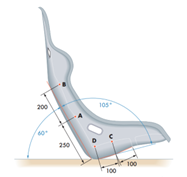
Competitors should choose a seat with an angle of approximately 105° between the backrest and base. This angle is measured using four reference points:
- Point A is located 250 mm from the seat base on the central plane,
- Point B is 200 mm directly above point A,
- Point C is positioned 100 mm rearward from the rearmost edge of the crotch strap slot,
- Point D is 100 mm rearward from point C.
The angle formed between line A-B and line C-D should be around 105°. The seat back itself, represented by the A-B line, should be positioned at approximately 60° from the horizontal. Research shows that rotating the seat back from 40° to 60° upright can reduce spinal-fracture-inducing forces by around 20% during heavy landings.
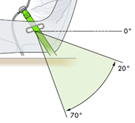
When installing the safety harness, the lap strap should be positioned as horizontally as possible, aligned tangentially with the top edge of the lap slot and forming a straight line between the anchorage point and the buckle. Adjusting the lap strap angle from 70° down to 20° has been shown to reduce spinal fracture force by around 10%.
The crotch strap should be directed as far forward as possible, aligned tangentially with the front edge of the crotch slot and forming a straight line between the anchorage and the buckle.
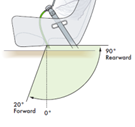
The shoulder straps should run slightly downward from the driver’s shoulders, ideally between 0° and 10° and never more than 20°. If the anchorage is placed higher than the shoulders, the driver can move vertically during an impact, reducing the restraining capacity of the harness and increasing the risk of injury. If the angle is too steep, the straps create extra compression on the spine, which also increases the likelihood of injury.
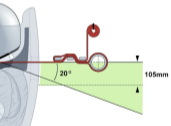
Maintaining the harness under proper tension during competition is essential as research shows that a tight harness can reduce the spinal-fracture-related force by around 5% compared to when it is left loose. Ensuring that the belts remain firmly tightened throughout the event plays a direct role in improving competitor safety during heavy landings.
For more details, we recommend reading the Cross-Country ChampionshipsCompetitor Installation Best Practice, available on the FIA Website.
There is extensive work ongoing within the FIA to further improve safety in Cross-Country competition, and competitors are strongly advised to read safety guidelines and bulletins. Key topics include the use of seat side head supports on homologated seats, correct installation of Frontal Head Restraint (FHR) devices and the introduction of the FIA seat attenuator.
More information on these and other initiatives is available at:
We kindly request your support to promote these updated Guidelines among your event organisers, officials, and volunteers.
Thank you for your continued commitment to improving safety across the sport.
Best regards,
FIA Safety Department