
Extinguishers
The FIA has developed and deployed safety standards for many items of on-board equipment used in competition vehicles, including the Frontal Head Restraint device, seat, roll cage padding, harness.
Dear colleagues,
The FIA has developed and deployed safety standards for many items of on-board equipment used in competition vehicles, including the Frontal Head Restraint device, seat, roll cage padding, harness. Whilst not their primary objective of these devices, fire resistance properties are an important feature of all of these standards.
To futher help protect competitors from the risk of fire, and depending on the category, the FIA regulations require cars to be equipped with either:
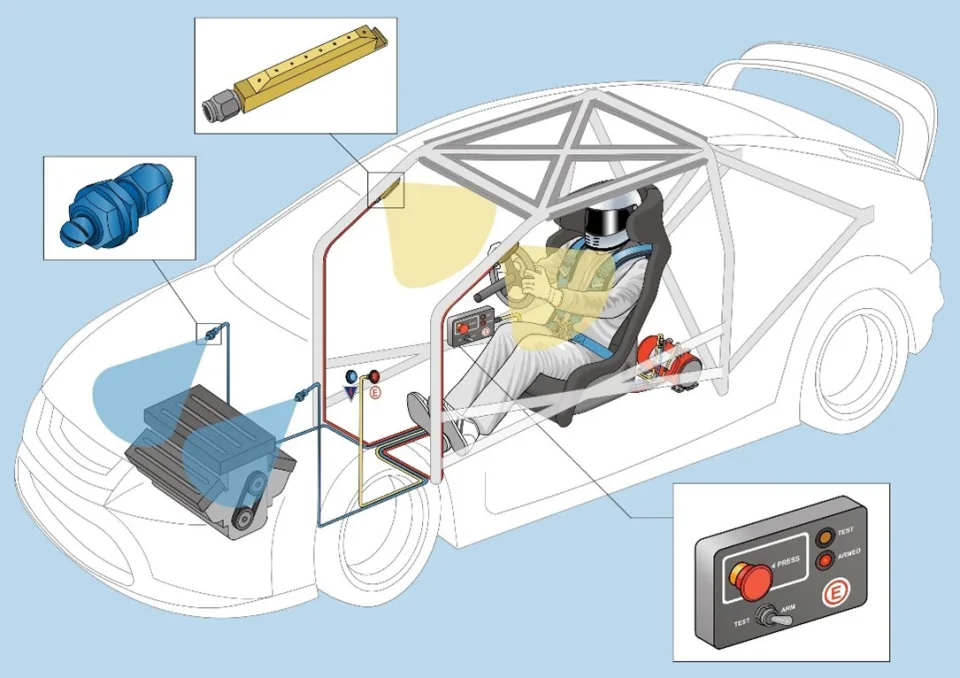
i) A plumbed-in fire extinguisher system.
ii) A hand-held extinguisher; or
iii) Both, hand-held and a plumbed-in fire extinguisher.
Plumbed-in fire extinguisher system – FIA Standards
There are three FIA Standards for plumbed-in fire extinguisher systems:
i) FIA Standard for Plumbed-in Fire Extinguisher Systems, published in 1998, for closed and open cockpit vehicles
ii) FIA Standard 8865-2015 “Plumbed-in and Hand-held Fire Extinguisher Systems" for closed cockpit vehicles
iii) FIA Standard 8876-2022 “Plumbed-In Fire Suppression System for Open Cockpit Cars”
Competitors are advised to check Appendix J and/or the Technical Regulations of the championship they intend to participate in to find out which standard is required.
The FIA Standards 8865-2015 and 8876-2022 offer several safety improvements in relation to the standard published in 1998. The main safety improvements are described HERE.
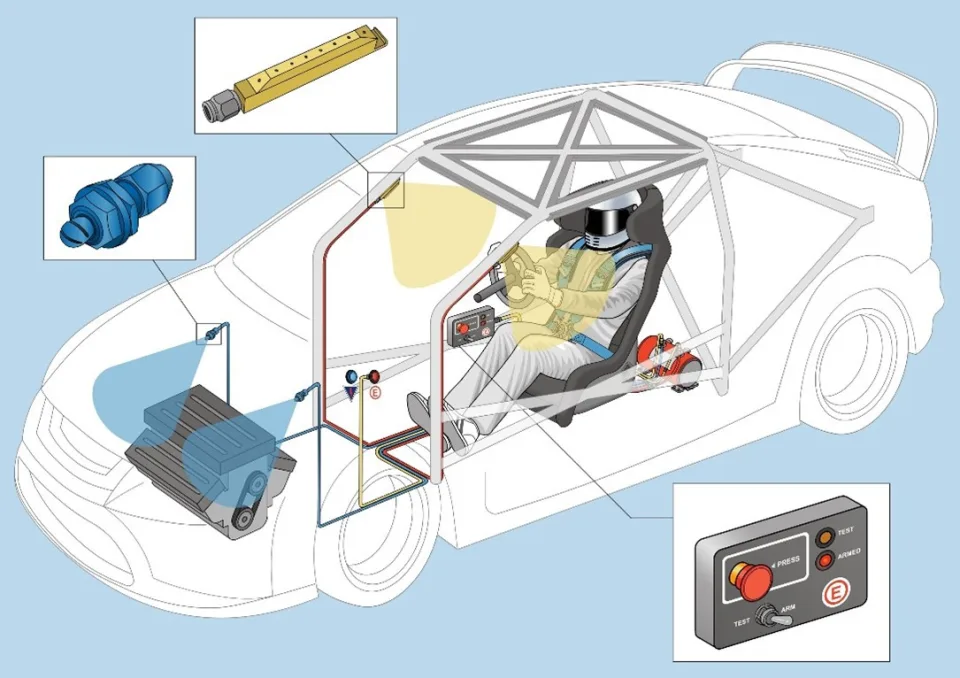
Plumbed-in fire extinguisher systems are mainly designed to delay the development of the fire and consequently give the competitors more time to exit the car.
Plumbed-in fire extinguisher system – Homologations & Installation
As the efficiency of all FIA-approved extinguishers is linked to the extinguisher system installation, it is important that the extinguisher system is installed in accordance with Appendix J and/or the Technical Regulations, as well as and the manufacturer user manual. All user manuals are available via a link at the top of the relevant technical list.
(Technical List #16, #52 and #97 respectively for the three standards listed above).

Technical List n°16

Technical List n°52
Technical List n°97
When installing the system in a car, the bottle, the lines, the nozzles and control box must be firmly fixed to the vehicle to prevent them from changing position under racing conditions. Nozzles must not point at the driver’s head when in driving position and must be fixed with metal fixing systems to ensure that they remain in place during a fire. The control box must be fixed in a location that the competitors and race officials can easily see/access. For pressurized systems, the bottle must have a gauge indicating the pressure level in the tank, and this must be in the “green” safe working pressure area in order for the device to be used.
The activation buttons must be accessible to the crew from inside the cockpit and to marshals from outside the car.
Specific requirements for vehicles with HV powertrain
For vehicles with an HV powertrain, only approved non-conductive extinguishing mediums such as FX G-TEC FE36 and Novec 1230 can be used in both the cockpit and engine compartments.
For internal combustion engine vehicles, the system must comply with the "class" of fire, which is defined according to the fuel used in the category the vehicle is participating in. This is valid for both plumbed-in and hand-held systems. However, for hand-held extinguishers, ABC-type extinguishers are also acceptable.
Hand-held extinguisher(s)
The installation of a hand-held extinguisher in vehicles is regulated by Articles 253 and 283 of Appendix J. In rallies and cross-country rallies, hand-held extinguishers can allow competitors to help others who are facing fire. They can also be used to fight fires in areas where the nozzles of the plumbed-in extinguisher system are not installed (e.g. areas outside of the engine bay and cockpit volumes, such as brakes, exhaust, etc.). The regulations define the number of fire extinguishers, the extinguishing agent medium and the respective minimum quantity, as well as the labelling and installation.
Key Points
Always Be Ready:
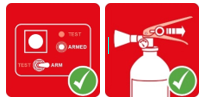
Arm the control box as you buckle up. Remove the pin of the mechanical or hand-held system before leaving the garage.
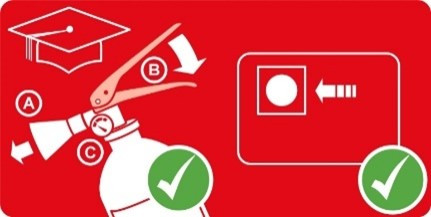
Familiarise yourself with the system and the triggering protocol.
Stop the car and activate the extinguisher immediately there is a fire.

Activate the plumbed-in fire extinguisher system at an early stage of the fire to increase effectiveness.
For Hand-held extinguishers:

Use any handheld extinguisher as soon as possible
Keep a safe distance.
Protect yourself from the fire, heat and smoke.
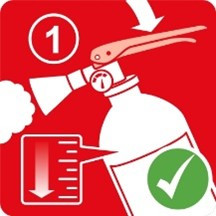
The first activation is the most efficient,
empty the bottle completely.
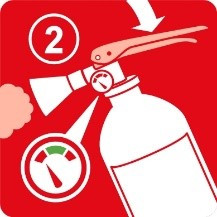
Commonly hand-held extinguishers are most efficient upon the first
activation.
The extinguisher is less efficient during the second
discharge due to pressure loss inside the bottle.
Social Media Post
(Please feel free to copy and paste this for use on your social media channels)
Today, we want to address an essential aspect: extinguisher systems. 🧯 🔥
Plumbed-in fire extinguisher systems are specifically designed to delay the development of the fire and consequently give the competitors more time to exit the car. As the efficiency of all FIA-approved extinguishers is linked to the extinguisher system installation, it is important that the extinguisher system is installed in accordance with Appendix J and/or the Technical Regulations, as well as and the manufacturer user manual.
In rallies and cross-country rallies, hand-held extinguishers can allow competitors to help others who are facing fire. They can also be used to fight fires in areas where the nozzles of the plumbed-in extinguisher system are not installed (e.g. areas outside of the engine bay and cockpit volumes, such as brakes, exhaust, etc.).
#FIASafety #FIAVisionZero
Best regards,
FIA Safety Department