Protective Clothing Customisation
Welcome to Issue #34 of the FIA Safety Bulletin. In this edition we’re looking at one of the most critical pieces of safety equipment available to competitors – overalls – and how customisation of overalls should be...
Dear Colleagues,
Welcome to Issue #34 of the FIA Safety Bulletin. In this edition we’re looking at one of the most critical pieces of safety equipment available to competitors – overalls – and how customisation of overalls should be approached within FIA regulations.
FIA Standards
The use and development of clothing materials in motorsport have evolved over time and continues to do so. The FIA aims to deliver standards that set design and safety performance requirements, with the goal of covering every category of the sport and protecting everyone, regardless of budget. As part of that mission, overalls approved according to FIA Standards 8856-2000 and 8856-2018 play a crucial role in protecting competitors.
Technical Lists
FIA Standards 8856-2000 and 8856-2018 set out the specifications for protective clothing (overalls, balaclava, undergarments, socks, shoes and gloves) used in motorsport events, with the aim of enhancing safety and minimising the risk of second-degree burns to competitors.
These FIA Standards specify that all protective clothing must pass several tests in order to be approved by the FIA, including those for flame, heat transmission, and tensile strength.
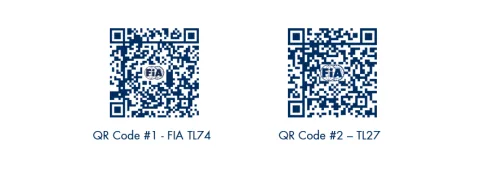
A full list of FIA approved clothing meeting FIA Standards 8856-2000 and 8856-2018 can be found in Technical Lists no. 27 and 74. The lists can be downloaded HERE or accessed by scanning QR Code #1 and #2. To assist with scrutineering activities, each product approved according to FIA Standard 8856-2018 has its own presentation form that can be downloaded via the technical list.
Correct Use and Customisation
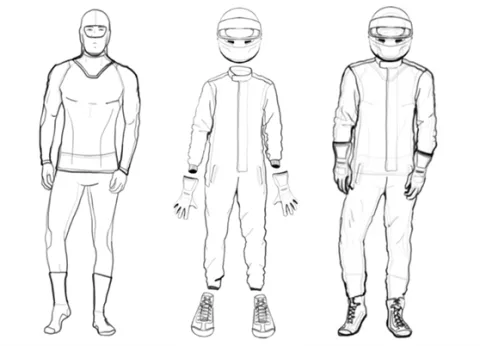
Competitors should always wear overalls that completely cover the body from the neck to the wrists and ankles and ensure that the overalls, when combined with the balaclava (overlap at the neck), undergarments, gloves and socks, guarantee at least two layers of protective clothing.
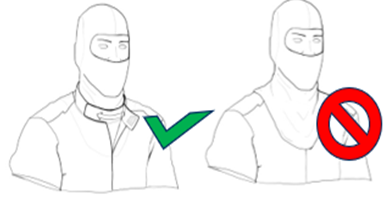
Article 2 “Flame-resistant clothing” of Chapter III “Drivers’ Equipment” of Appendix L to the ISC, which can be downloaded HERE, regulates the customization of clothing. The regulation has been written to ensure that customization does not reduce the safety performance of the clothing, and therefore it is important that competitors follow the customization regulation.
Competitors have at their disposal three different ways to customise their clothing:
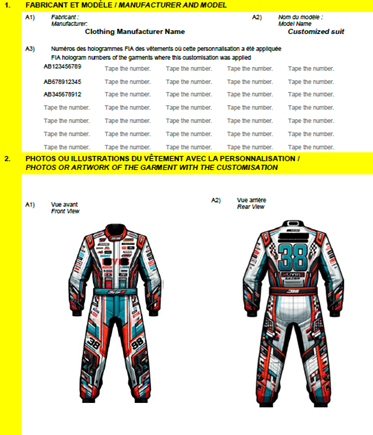
1. Printing and Transfer – This process may only be undertaken by the clothing manufacturer. For FIA-approved 8856-2018 garments, any customization via printing or transfer must be supported by a certificate from the manufacturer (see below example). This certificate may be supplied in paper format, via email, or directly accessed via QR code or NFC on the equipment. Although there are no customization certificates for clothing approved in accordance with 8856-2000 standard, printing and/or transfer can only be done by the clothing manufacturer.
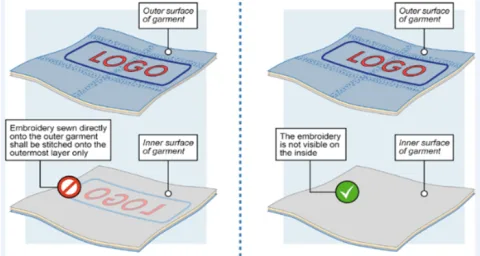
2. Embroidery – Any embroiderysewn directly onto the garment must be stitched onto the outermost layer only to ensure better heat insulation (same regulation for 8856-2000 and 8856-2018 approved clothing).
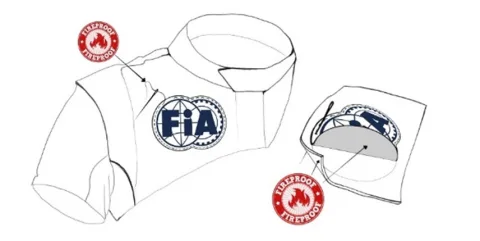
3. Addition of badges – The backing material of badges and the thread used for affixing them to the garment must be flameproof. The stitching of badges can go through all layers, provided that the thread is flameproof and compliant with ISO 15025 (same regulation for 8856-2000 and 8856-2018 approved clothing).
Protective clothing may be customised to suit the needs of a competitor with disabilities. However, these modifications must be carried out solely by the manufacturer. Once again, customised clothing approved in accordance with 8856-2018 standard must be accompanied with a customisation certificate showing these modifications.
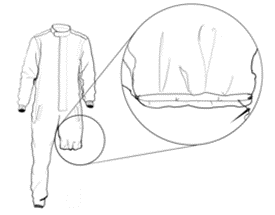
Finally, it is important to note that coloured dye is prohibited as it can change the properties of the materials and reduce the safety performance of the overalls.
Social Media Post
(Please feel free to copy and paste this for use on your social media channels)
The use and development of clothing materials in motorsport have evolved over time and continues to do so. The FIA aims to deliver standards that set design and safety performance requirements, with the goal of covering every category of the sport and protecting everyone, regardless of budget. All information can be found on the FIA website at fia.com.
#FIASafety #FIAVisionZero
Best regards,
FIA Safety Department